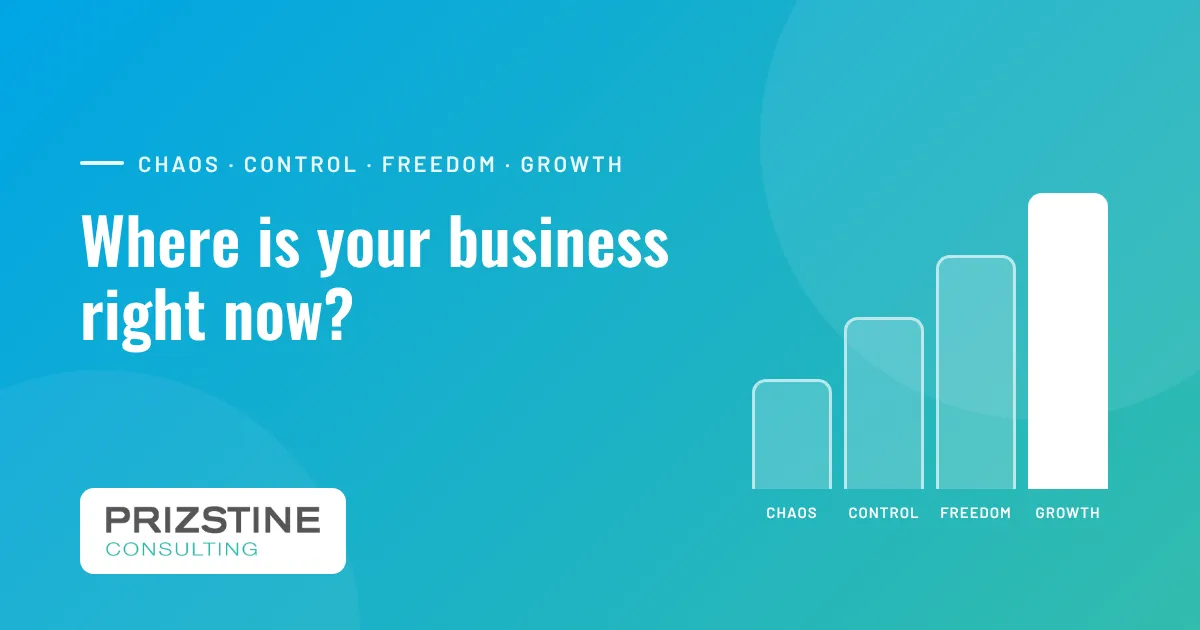
Chaos, Control, Freedom, Growth: Where Is Your Business Right Now?
Every business sits somewhere on a path. Most owners can tell you their revenue to the dollar, but ask where the business sits on that path and the answer is usually a shrug.
That matters, because the right next step depends entirely on where you are now. Here are the four stages, how each one feels from the owner's chair, and how to find out which one you are in.
The Four Stages
Chaos. Everything depends on you. Long hours, constant firefighting, and every decision requires your direct involvement. The business may be busy and even profitable, but it only works while you are in the room. The next move is getting the basics of structure in place: direction, defined roles, visibility over your numbers, and simple systems.
Control. Structure takes over. Roles are defined, numbers are visible, and decisions no longer rely on guesswork or memory. You still carry a lot, but you are no longer carrying it blind. The next move is turning that structure into consistent execution across the team.
Freedom. You get your time back. The business runs on systems and accountability, not on how many hours you personally put in. You can step away and things keep moving. The next move is deciding what you want the business to do with that freedom.
Growth. The business scales without you. What was once dependent on the owner becomes an asset that performs on its own. The next move is growing deliberately, with the right people in place, rather than adding complexity to a fragile base.
Revenue Is Not The Measure
A business can turn over a strong revenue number and still sit firmly in Chaos. These stages measure structure, not size. The question is not how much the business earns. It is how much of it depends on you.
That is why two businesses with the same turnover can feel completely different to run. One owner is firefighting every day. The other is reviewing the numbers on a Monday and getting on with the week.
Why It Pays To Know Your Stage
Skipping a stage rarely works. An owner who tries to scale a business that is still in Chaos usually adds more people, more clients and more complexity to a base that cannot hold them. The pressure grows with the business.
Doing the right work for your current stage is faster than doing the exciting work for the next one. It also keeps you from fixing the wrong problem, which is one of the most expensive mistakes an owner can make.
How To Find Out
The PAVE Business Scorecard has 40 questions, ten for each of the four pillars: Purpose, Accountability, Visibility and Efficiency. Each answer is scored from 1 to 5, which gives a total out of 200. Your total places you in one of the four stages.
Total score | Stage |
|---|---|
40 to 79 | Chaos |
80 to 119 | Control |
120 to 159 | Freedom |
160 to 200 | Growth |
Answer honestly. The Scorecard is a thinking tool, not a test, and flattering yourself only delays the useful part.
What To Do With Your Result
Whatever your stage, the aim is the same: a business that performs without relying on you for everything. Your results page shows where you are and where to focus first. Choose one thing from it and act on it this week.
If you are not sure where you stand, the quickest way to find out is to ask the questions.


